Digital Project
Frank Gehry — Relational storytelling for paradigm-shifting architectural process
Exhibition systems · multi-screen media · touring installation
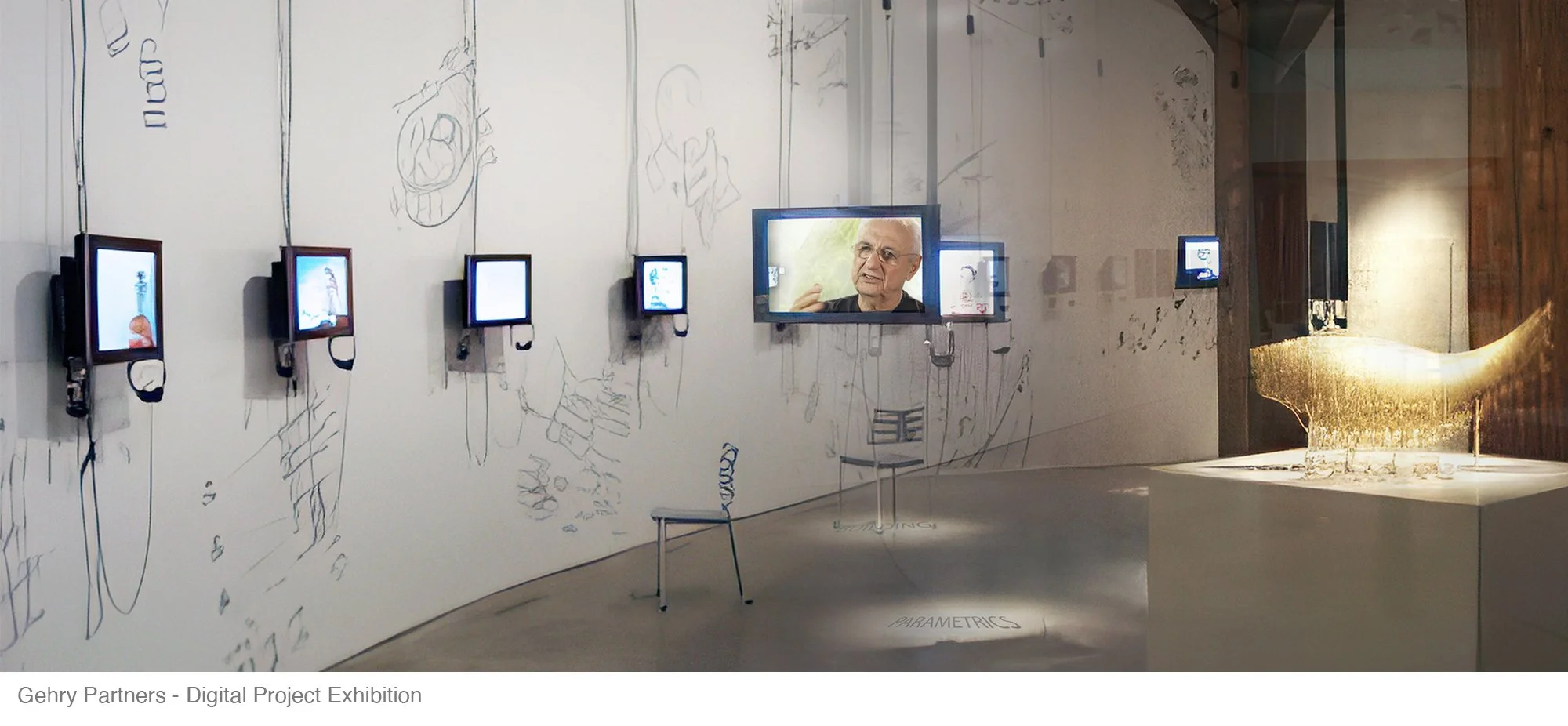
Danish Architecture Center. Copenhagen.
Overview
Digital Project was a large-scale, touring exhibition developed to make legible the paradigm-shifting design and construction methodologies emerging from Frank Gehry’s practice.
Commissioned by the Danish Architecture Center following an earlier installation created for a major Gehry retrospective at MOCA-LA, the project translated a deeply technical architectural process into an experiential, public-facing narrative. Rather than explaining outcomes, the exhibition focused on revealing the collaborative process—how architecture is conceived, negotiated, and realized.
“The exhibition revealed a paradigm-shifting methodology in the complex relationships between architecture, engineering, and construction.”
The Problem
For decades, architectural innovation operated within an AEC framework that privileged the concerns of engineering and construction above those of the architecture—a condition Gehry described as “infantilization of the architect.”
In response, Gehry Partners developed a radically different approach, integrating 3D technologies borrowed from aviation, shipbuilding, and CAD/CAM manufacturing directly into design and construction workflows. Over time, this led to a profound shift: the 3D model became the central, contractual artifact—collaboratively built yet architect-owned—rebalancing power across disciplines and enabling unprecedented architectural forms to be realized on time and on budget.
The challenge was how to communicate this transformation to non-specialist audiences without reducing it to a linear or technical explanation.
The Conceptual Shift
The project rejected the idea of a single authoritative narrative.
Instead, it treated Gehry’s design process as a relational system—one best understood through overlap, repetition, and proximity rather than sequence. Meaning would not be delivered; it would be assembled.
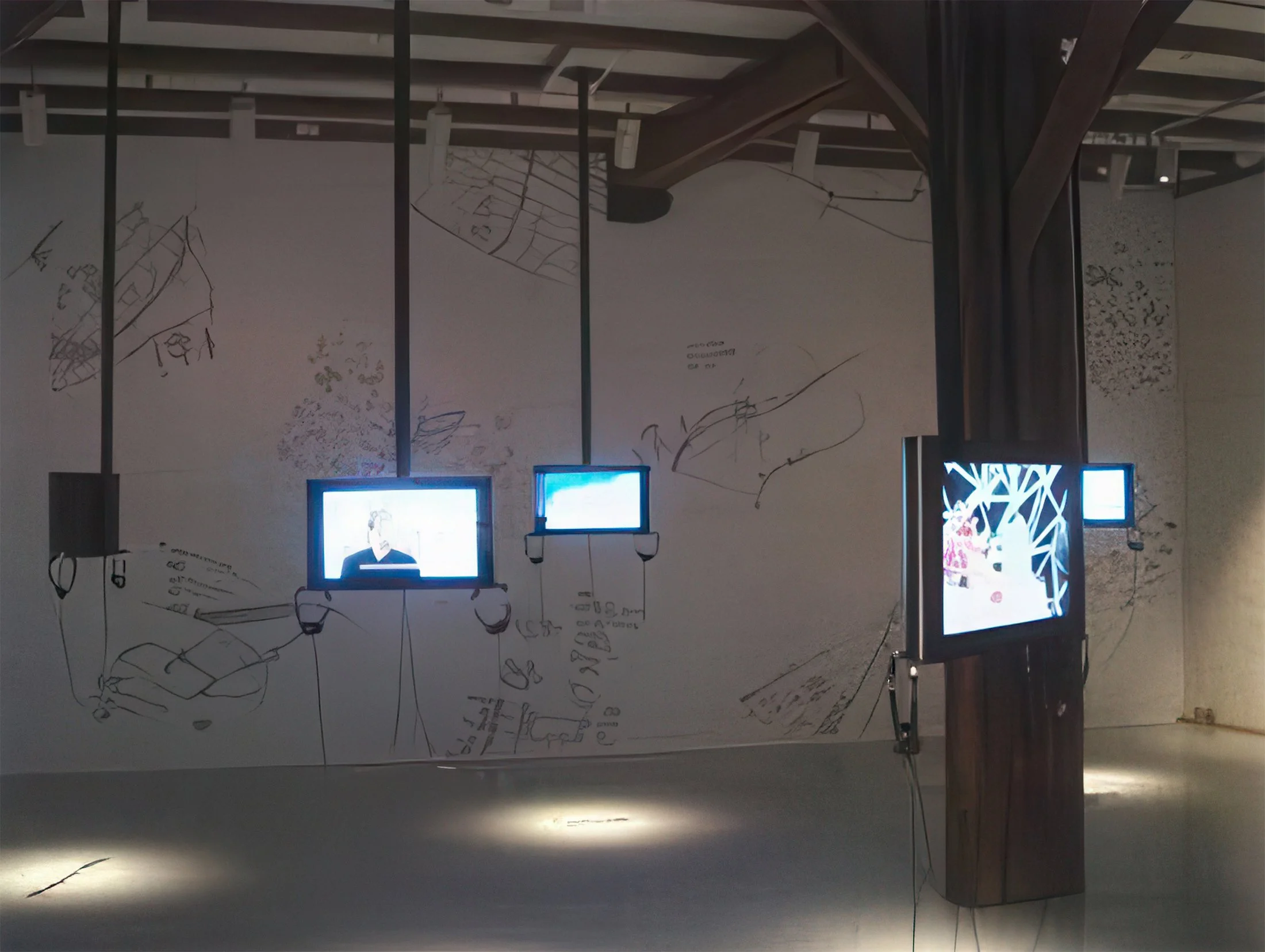
Building on insights from an earlier MOCA-LA installation, the exhibition used spatialized media and directed audio to guide attention while preserving openness. Viewers were encouraged to wander, encounter fragments, and construct understanding indirectly—mirroring the iterative and collaborative nature of the architectural process itself.
How the System Took Shape
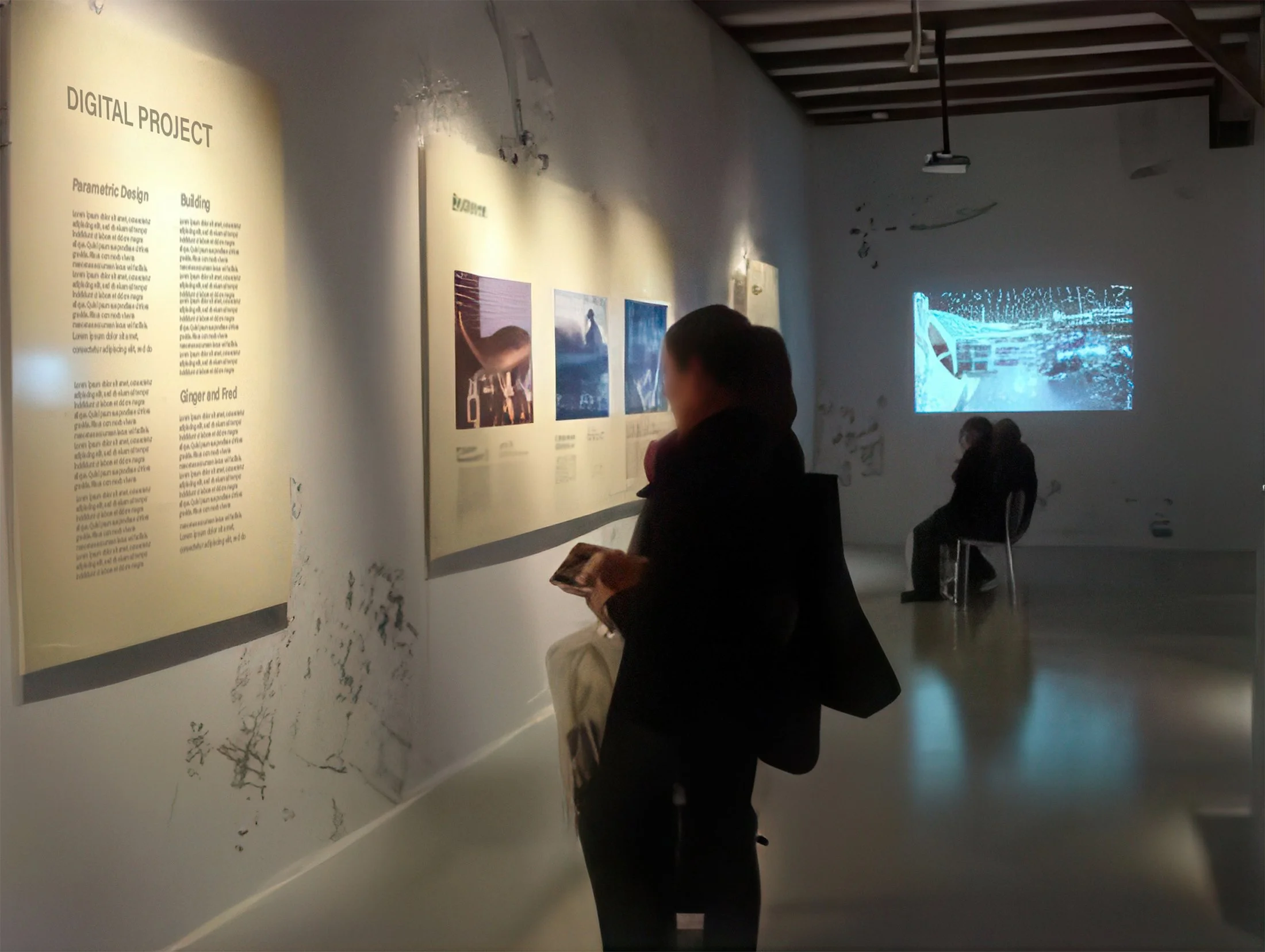
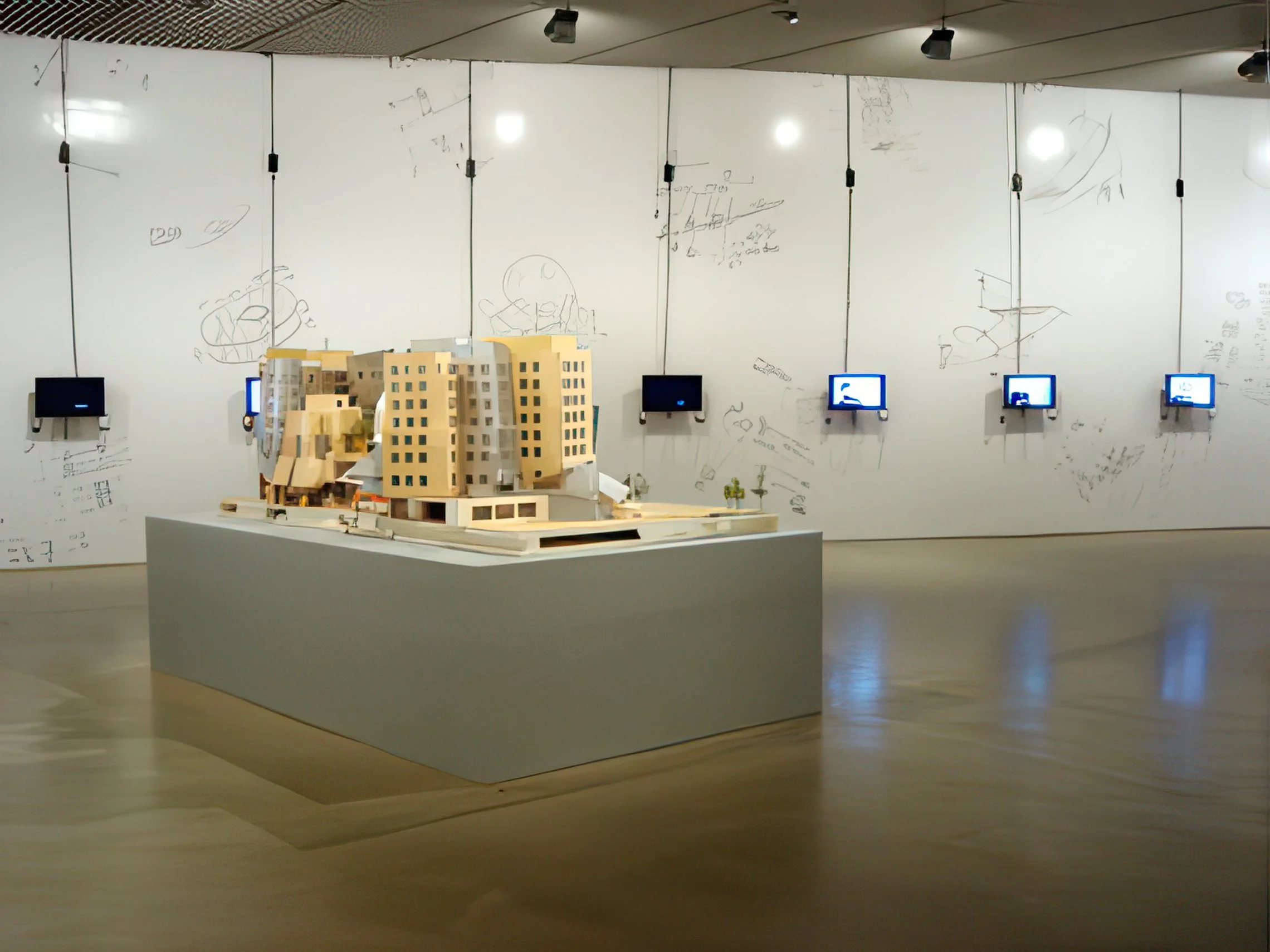
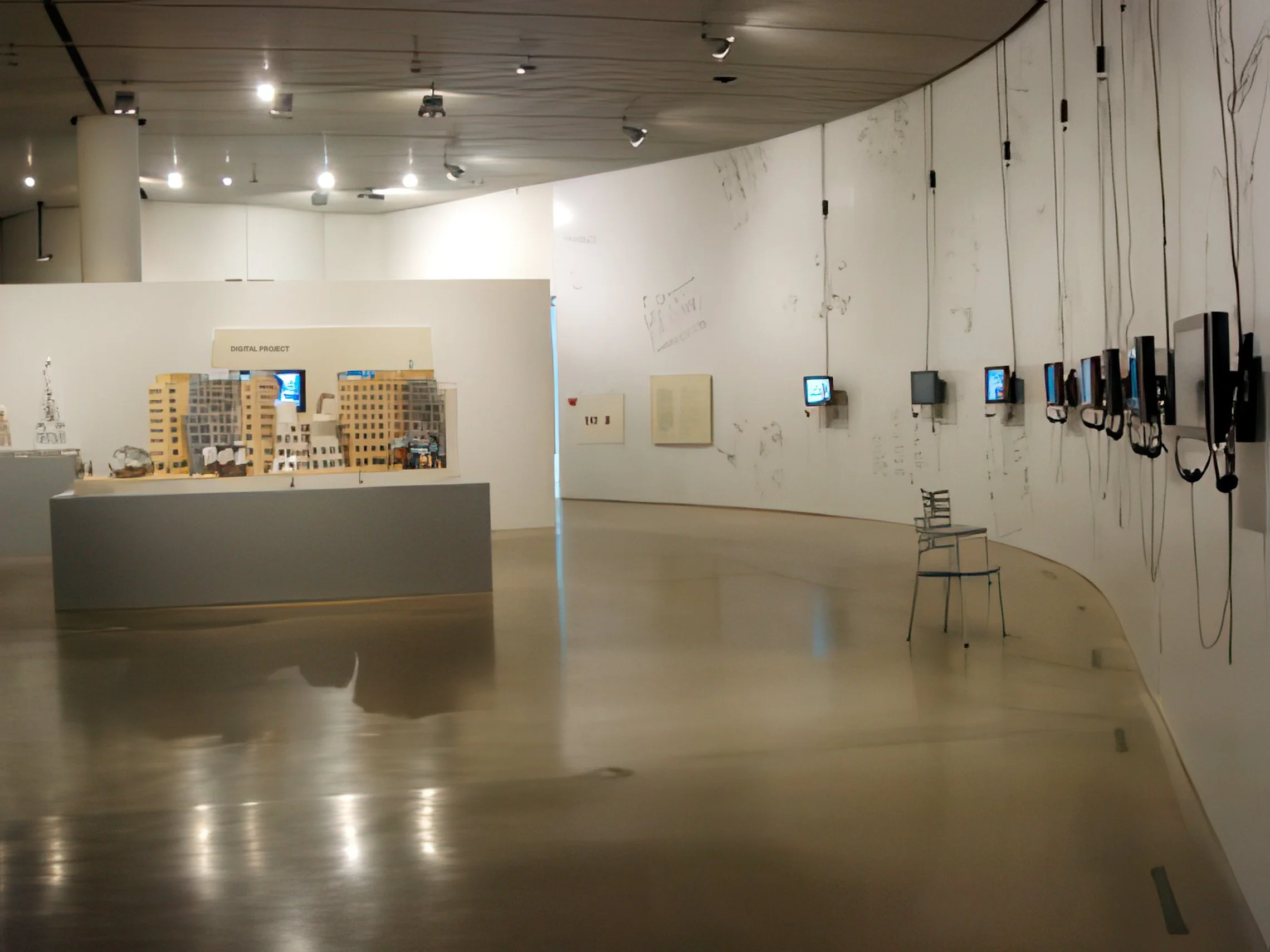
The exhibition comprised multiple video screens displaying looping sequences, motion graphics, and interviews with senior Gehry Partners staff, shot against green screen and interwoven across themes.
Directed audio—delivered through sound domes and headphones—acted as a subtle attentional guide, drawing viewers into specific narratives without prescribing a fixed path. Physical displays and graphic elements grounded the media within a spatial field, reinforcing the sense of interconnected systems at work.
The result was an open, non-linear environment in which visitors could navigate the architectural process, assembling insight through movement and attention rather than instruction.
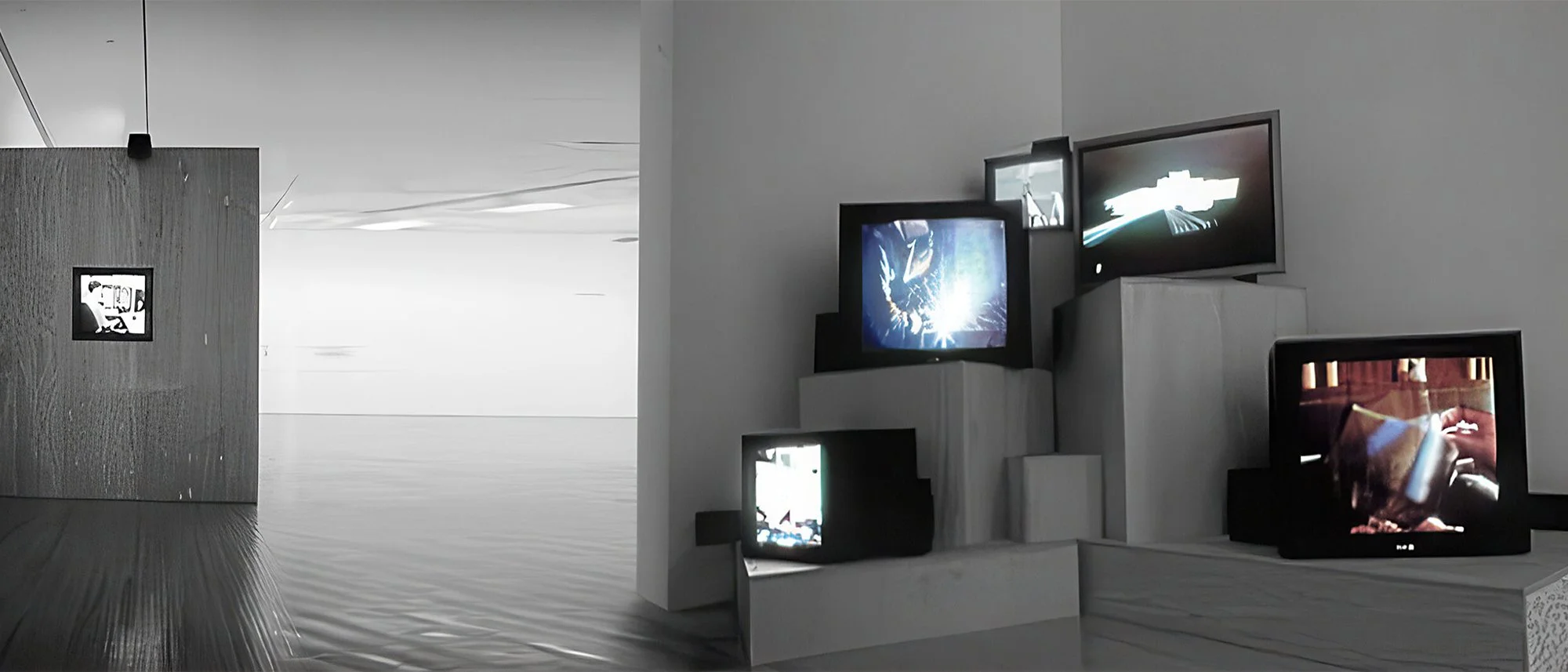
The original video installation for Gehry Retrospective, MOCA-LA
Why It Mattered
Digital Project demonstrated how highly specialized architectural intelligence could be translated into a public, experiential form without losing depth.
The exhibition toured extensively at major international cultural venues, including the Danish Architecture Center, Vitra Design Museum, Triennale di Milano, Design Museum London, the National Building Museum, and others—reaching diverse audiences across professional, cultural, and educational contexts.
More broadly, the project established a model for relational storytelling: communicating complexity by designing conditions in which understanding can emerge through connections made intuitively and experientially.
Role
Creative Direction
Concept Development & Ideation
Concept / Content R&D
Project Research
Video Direction
Relational UX / Attention Design
Project Leadership
-
![page 1]()
01
-
![page 2]()
02
-
![page 3]()
03
-
![page 5]()
04